
Stories / Outside the window / story 8 of 18
The four wet months
An AC in the monsoon works hardest on damp air rather than heat, so keep the filter clean, use the drying setting if you have one, make sure the drain flows, and have a technician look if water has reached the wiring.
From The AC in Your Flat. Updated 4 November 2026.
Mumbai's monthly rainfall average for July is about 840.7 mm by the IMD figure quoted in The Free Press Journal. Figures reproduced on Wikipedia's page from IMD data for 1991 to 2020 give about 23 rainy days that month at Santacruz, and 17:30 relative humidity of about 81 per cent. So the AC spends the wet months working on moisture.
Does rain harm an outdoor unit?
Outdoor units are built to live outdoors. We found no maker saying ordinary rain is a problem on a properly fitted unit. The risks are around it: a bracket on a wall that's been wet for months, loose pipe runs and a blocked drain.
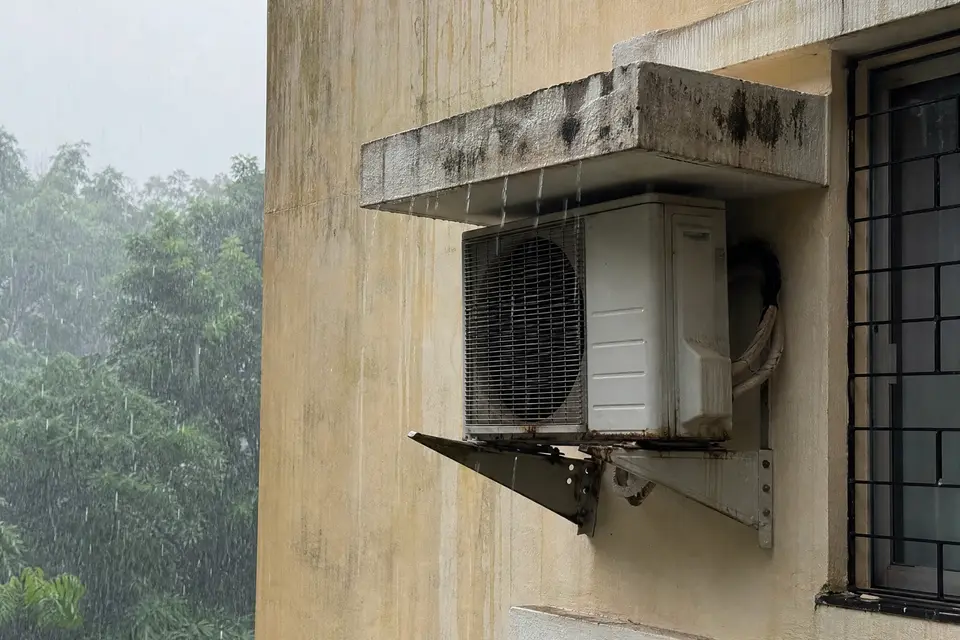
Should you cover the outdoor unit?
Not while it's running. Daikin India's manual says not to block the air inlets and outlets of either unit, and its troubleshooting page lists blockage as a reason for a shutdown. A plastic sheet tied on in June and forgotten can do this. If one has been tied on, ask a technician to take it off.

Eastern Freeway under monsoon cloud. Thick air and low light can fool you into thinking the AC isn't needed; the humidity says otherwise. 
Green everywhere means damp everywhere, and it means leaves and seeds around any unit at ground level. 
Rajmachi, in the Sahyadri. Pune and the ghat towns get cooler air but keep the damp.
What about mould and smells?
After the rains is when smells show up. Use the drying setting, and read the musty smell story. If the AC won't be used for weeks, Daikin's steps are to dry the unit on a sunny day, then turn off the plug or dedicated breaker and take out the remote's batteries.
What if water reaches the unit or the wiring?
Keep it off. If a flood or a leaking ceiling has wet the unit, socket or stabiliser, switch off at the MCB only if your hands are dry, you aren't standing in water and the board itself is dry, and leave it off until an electrician or technician has checked it. This is common-sense caution rather than a maker's rule, and it costs one phone call.
What to do
Yours to do
- Clean the filter more often when windows have been open.
- Keep plants, buckets and stored items clear of a unit you can walk up to.
- Keep the power off after any flooding or ceiling leak near the wiring.
Leave to the trained person
- Checking brackets, pipe insulation and the drain line before and after the rains.
- Taking off any cover or shed that's boxing the unit in.
Also asked
Should I run the AC when it's raining?
In ordinary rain, yes if you want to. It's a matter of comfort and of your bill. In a severe storm, switching off is the cautious choice. LG's India guide puts dehumidification first for humid cities, so check whether your model has a dedicated mode.
Will my AC trip in a storm?
It may, for many reasons. Voltage swings can stop some models, and Daikin says they restart in about three minutes. See stabilisers and power cuts.
Where this came from
- The Free Press Journal, 16 July 2020: July rainfall average at Mumbai
- Climate of Mumbai, Wikipedia tables from IMD data: Rainy days and humidity, 1991 to 2020, as reproduced
- Daikin India, room AC operation manual: Do not block inlets and outlets, Daikin India manual
- Daikin, troubleshooting: Long gaps, drying, shutdown causes
- LG India, AC capacity guide, May 2026: Humid cities
This story rests on those pages, opened or checked by 4 November 2026, and on no tests of our own. Maker pages speak for their makers, and rules and wiring differ by building, so check your own manual.